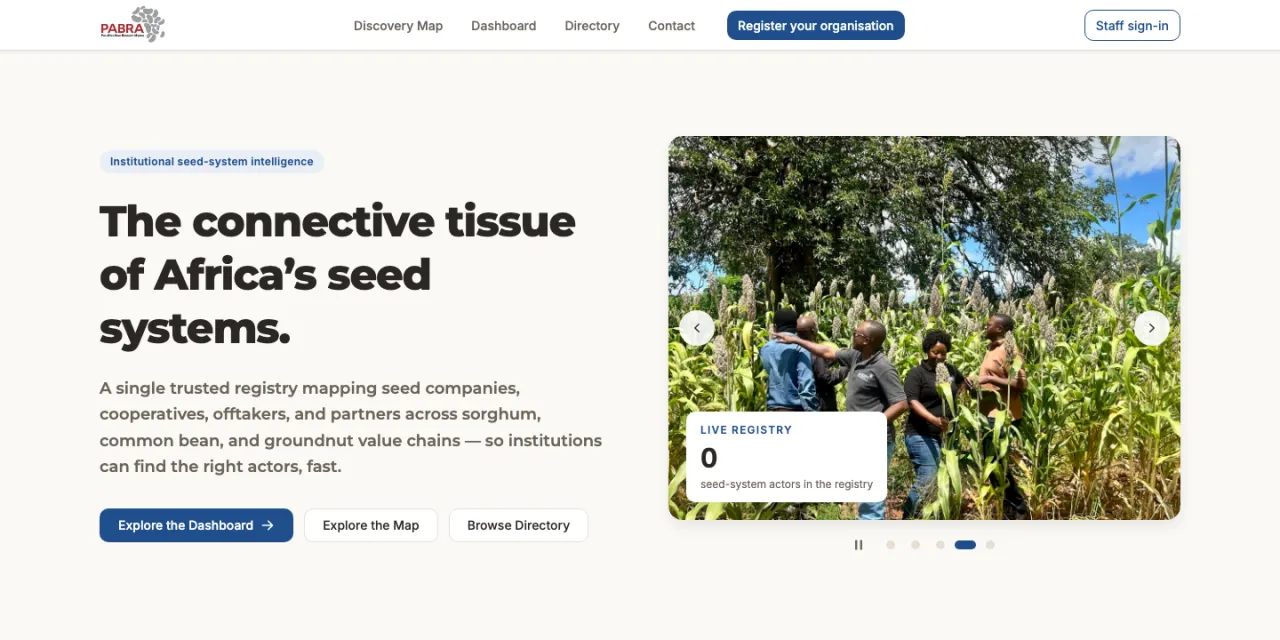
Data on the organizations that make up Africa's sorghum, common bean and groundnut seed systems was scattered across static CSV/Excel files. There was no trusted public place where institutions and partners could find those actors.
The approach
A public web platform on a single governed database:
Searchable directory of organizations.
Interactive map of Africa.
Discovery dashboard with data download.
Public self-registration with human review before anything is published.
The core design decision is consent-based disclosure: an organization is visible only after it consents, and its contact details appear only on its own profile page, never in lists, maps or downloads.
The outcome
Covers all 54 African countries and 949 official regions.
Began under the ACCELERATE project in Tanzania, led by the Alliance of Bioversity International & CIAT and PABRA (Pan-Africa Bean Research Alliance) with Gates Foundation funding; it is now a PABRA product.
Covers all 54 African countries and 949 official regions.
Began under the ACCELERATE project in Tanzania, led by the Alliance of Bioversity International & CIAT and PABRA with Gates Foundation funding; now a PABRA product.
Documented in an open-access technical report (CC BY, 2026) on its design, implementation and development pathway.